NCHR Participates in the 63rd Session of the Human Rights Council in Geneva
The National Council for Human Rights (NCHR) participated in the 63rd session of the United Nations Human Rights Council in Geneva through a high-level delegation headed by Mr. Mohamed Anwar El-Sadat, NCHR Vice President. The participation reflects NCHR’s commitment to active engagement with international human rights mechanisms and its continued efforts to strengthen communication and interaction with United Nations mechanisms and relevant international and regional human rights institutions. The delegation in Geneva also includes Ms. Yara Kassem, NCHR Board Member.
On the margins of the 63rd session, NCHR’s delegation held a number of meetings with senior officials and representatives of international and regional human rights bodies. The meetings addressed ways to strengthen cooperation, coordination, and the exchange of expertise, as well as a number of issues and topics of mutual interest.
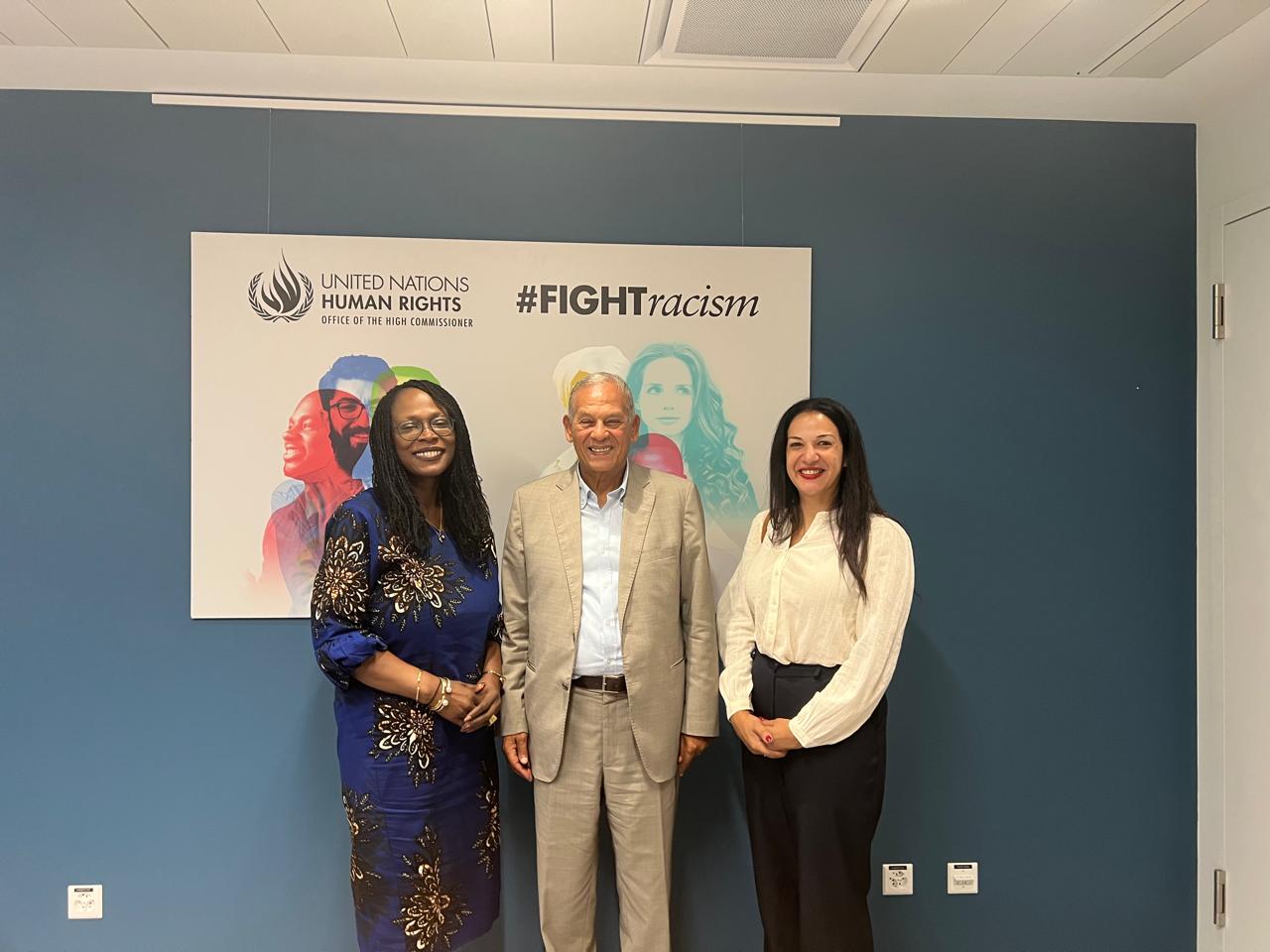
In this context, the NCHR delegation met with Ms. Awa Dabo, Deputy High Commissioner for Human Rights, where discussions focused on strengthening communication and cooperation between NCHR and the Office of the United Nations High Commissioner for Human Rights (OHCHR), as well as exchanging views on a number of issues related to the protection and promotion of human rights.
The delegation also met with Mr. Idrissa Sow, Chairperson of the African Commission on Human and Peoples’ Rights (ACHPR), and Dr. Litha Musyimi-Ogana, ACHPR Commissioner and Country Rapporteur for Egypt. The meetings addressed ways to strengthen cooperation and communication between NCHR and ACHPR, as well as the exchange of views on a number of human rights issues relating to Egypt and the African continent.
As part of its participation in the substantive discussions of the session, NCHR delivered a written statement and submitted a video intervention during the interactive dialogue with the Special Rapporteur on the Human Rights to Safe Drinking Water and Sanitation. This contribution was made in the exercise of NCHR’s mandate as Egypt’s independent national human rights institution. NCHR’s contribution addressed the key issues raised in the Special Rapporteur’s report, while presenting its perspective on the challenges and opportunities related to the effective realization of the human rights to water and sanitation in Egypt.
In its contribution, NCHR expressed its appreciation for the progress acknowledged in the report in expanding access to drinking water and sanitation services, as well as for the efforts and initiatives highlighted in this regard, including the “Haya Karima” initiative. At the same time, NCHR stressed that the challenges associated with water scarcity and climate change make the sound, equitable and sustainable management of water resources a matter of significant importance from both a human rights and development perspective.
NCHR highlighted the importance of addressing disparities in access to water and sanitation services, particularly in rural and poorer areas, emphasizing that the expansion of services should be accompanied by ensuring their affordability, non-discrimination and prioritization of those most in need, thereby guaranteeing effective and equitable access to safe drinking water and sanitation services. NCHR’s contribution also addressed issues relating to water quality, pollution and environmental monitoring, stressing that the human right to water is not limited to the availability of services, but also requires effective and regular monitoring and inspection, as well as strengthening the capacities of the relevant authorities.
NCHR also attached particular importance to the observations contained in the Special Rapporteur’s report concerning access to data and information on water quality, emphasizing that the regular and accessible publication of such information contributes to strengthening public trust, transparency and accountability. In this regard, NCHR reiterated the importance of moving forward with the adoption of a dedicated law on freedom of information, in implementation of the relevant constitutional provision.
NCHR further stressed the importance of safe and effective public participation in the formulation of policies and decisions relating to water and sanitation, including the participation of women, local communities, civil society organizations and human rights defenders, while emphasizing the need to safeguard the rights of groups in situations of heightened vulnerability.
As part of its cooperation with United Nations human rights mechanisms, NCHR noted that it would have welcomed the opportunity for the Special Rapporteur to engage with the Council during his visit to Egypt, in its capacity as the country’s independent national human rights institution. Such engagement would have provided an opportunity for a direct exchange of views on the issues addressed in the report. NCHR affirmed its interest in continuing dialogue and cooperation with the Special Rapporteur in the future.
Concluding its intervention, NCHR stressed that recognition of the progress achieved does not diminish the existence of continuing challenges requiring attention and action. It called upon the Egyptian Government to give serious consideration to the recommendations of the Special Rapporteur, while affirming its readiness, within the framework of its independent mandate, to follow up on the implementation of relevant recommendations and to engage in dialogue on them with national authorities, civil society and affected communities. NCHR also reaffirmed its commitment to continuing cooperation with the Special Rapporteur and United Nations human rights mechanisms, with a view to advancing the effective realization of the human rights to water and sanitation for all, without discrimination.
NCHR’s participation in the 63rd session of the United Nations Human Rights Council, through its delegation, meetings with international and regional officials and mechanisms, and contributions to the substantive discussions of the Council, reflects its commitment to strengthening its engagement and interaction with the international and regional human rights system and to presenting its independent perspective on the issues under discussion, in accordance with its constitutional mandate and its role in protecting and promoting human rights and public freedoms in Egypt.
 English
 Arabic
 French